
Time to decision
Why the Brand Strategic Plan needs to change

Nothing is possible in the future that is impossible today.
The speed with which you gain insight into what works and what is wanted has been a classical definition of innovation throughout history. Either can come first.
So, reduced to a strategic imperative, the only question that remains is: how do you increase your speed to that insight asymmetrically? That is, ahead of competition.
Unfortunately, the way that pharma works tends to reward the opposite. Early decisions about a fixed path tend to lead to 'Target Product Profiles', 'Brand Strategic Plans' and worse. BSP's don't reward curiosity. They say: this is what we're developing - figure out how to make the best of it. They never say: let's figure out if/ what to launch. Until the decision to go to a registrational study, all the 'strategic plan' should include is: what do we need to learn, and what is the best way to do that?
I always loved the two adages about lampposts:
companies use market research like a drunk uses a lamppost: for support, rather than illumination
if you lose your keys on a street lit by only one lamppost, searching in its light may be easy, but probably unproductive (the streetlight effect)
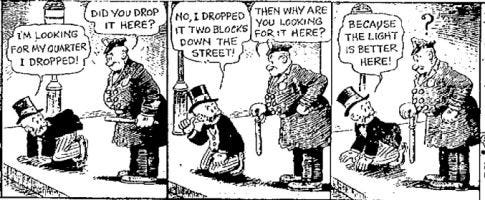
Both of those rely on the illumination offered by certainty. The dark parts of the street, or the drunkard's walk, offer deep uncertainty. Depending on the location, you may well be right to be uncertain in the shadows. However, if you are a pharma company looking to optimise the time from molecule to successful market position, the keys almost certainly lie in the uncertain. So, your task is to bring the light.
Shortening the time to the right decision will come down to having people who know the answer (hard, when the answer is meaningful), or having people incentivised to learn in a usefully 'wicked environment'. As Jeff Bezos says: ‘Our success at Amazon is a function of how many experiments we do per year, per month, per week, per day. Being wrong might hurt you a bit, but being slow will kill you.' In a useful additional perspective, Google X's take on this is: 'Moonshots don't begin with brainstorming clever answers. They start with the hard work of finding the right questions.'
One immediate change that can be made in pharma is to change the role of 'planning' from the fixed starting point that is typically presented ('we're launching here, let's make the best of it') to exploration. Discovery shouldn't be the role of the R in R&D, but the role of the whole company.