
Acquiring Biotech Innovation: Why Big Pharma’s External Bets Often Outperform Internal Discovery (At Lower Risk-Adjusted Cost)

In the world of pharmaceutical innovation, one truth stands out: the path from molecule to market seems littered with ‘failure’. (Let’s accept that ‘failure’ is a broad category of a lot of things - an opportunity for asymmetry…) We all know the (rough) averages: industry-wide likelihood of approval (LoA) from Phase I hovers around 7-10% in recent analyses, with the fully capitalised cost of each successful drug - including failures - running into billions. Yet large pharma companies have increasingly turned to biotechs - not just for licensing assets, but for outright acquisitions - to refill pipelines. Is this a sign of internal R&D weakness, or a smarter, more asymmetric way to play the odds?
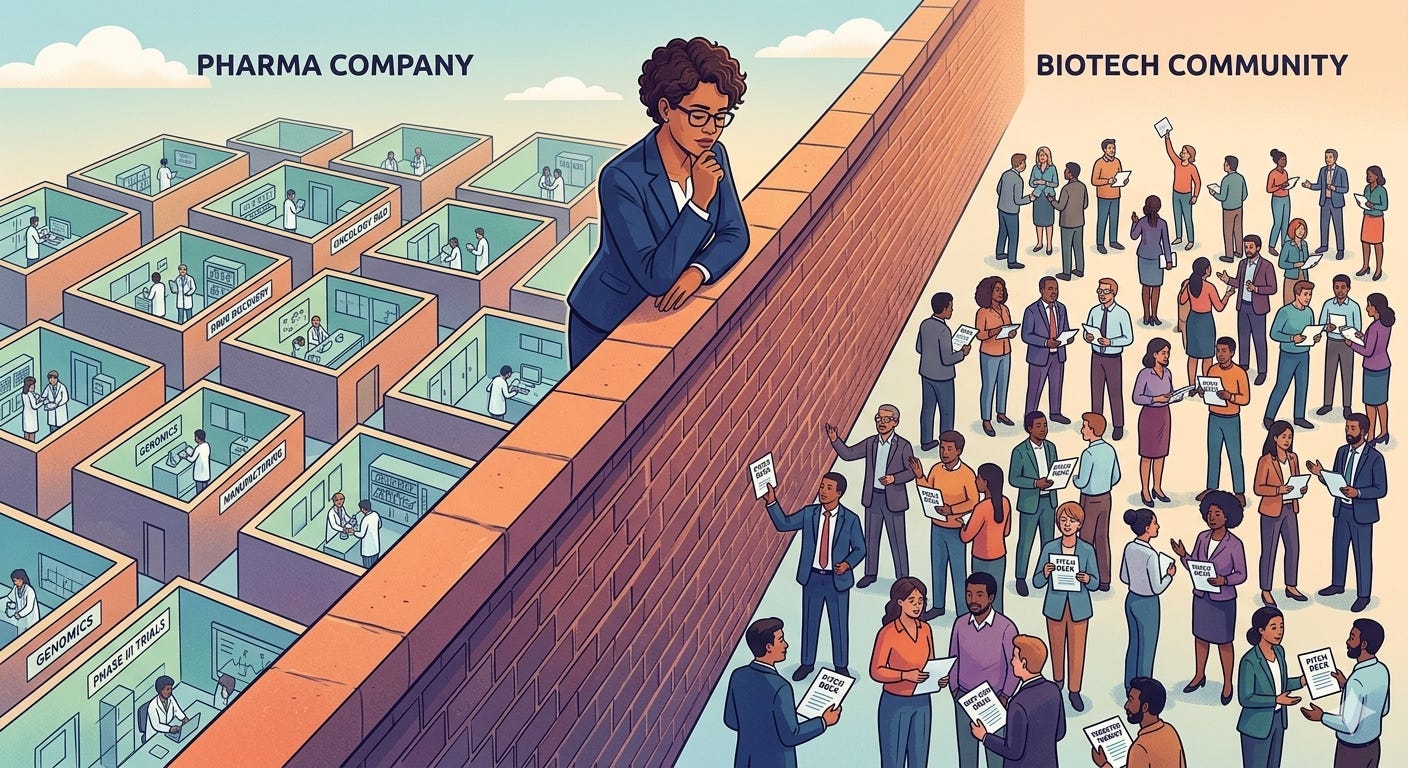
The data suggests the latter. Acquiring or licensing from biotechs often delivers higher clinical success rates and, crucially at today’s lower biotech valuations, better risk-adjusted economics than going it alone from discovery. But it’s not without nuance - especially when examining how individual big players perform against the average and what lessons emerge from contrasting strategies.
Internal vs External: The Success Rate Gap
Clinical development remains a brutal filter. Recent benchmarks put the composite Phase I-to-approval success rate at around 7-10%, though large pharma as a group outperforms the broader industry (often dragged down by smaller biotechs with riskier assets).
External assets - whether licensed or acquired from biotechs - frequently beat internal benchmarks. In-licensed or partnered projects have shown meaningfully higher phase transition probabilities, with some analyses indicating 12-17% advantages in early phases and 11-18% in Phase III. Partnered assets have nearly doubled non-partnered success rates from Phase I to launch in certain multi-year windows (e.g., ~19% vs ~9%).
Selection effects explain much of this: biotechs typically only advance assets with compelling early data to a deal stage, de-risking them for Big Pharma. External origin now dominates approvals, with 60-70%+ of recent NMEs stemming from outside large pharma labs, biotechs being a primary source.
Big Pharma vs Industry Average - and the Standouts
A comprehensive 2006-2022 benchmarking study of 18 leading companies calculated an average Phase I LoA of 14.3% - well above the industry norm. Yet the asymmetry missed in the ‘average’ is telling: Amgen led at ~22.8%, followed by Novo Nordisk (~20.7%) and Eisai (~18.4%). At the lower end sat AbbVie (~8.1%), Astellas (~8.6%), and GSK (~9.1%).
Amgen and GSK illustrate divergent approaches with instructive outcomes.
Amgen: Targeted Acquisition Engine
Amgen has combined a focused internal pipeline with high-impact biotech acquisitions, yielding top-tier success rates. Deals such as Horizon Therapeutics (2023, ~$27.8 billion) brought first-in-class rare disease assets like TEPEZZA (thyroid eye disease), KRYSTEXXA (gout), and UPLIZNA - strengthening its inflammation and nephrology portfolio and delivering immediate revenue and pipeline depth. Earlier moves included ChemoCentryx (TAVNEOS for vasculitis, 2022) and others like Five Prime and Teneobio, emphasising platform technologies and de-risked clinical assets.
This strategy aligns with Amgen’s high LoA: it buys validated shots on goal in areas like oncology (e.g., IMDELLTRA for small cell lung cancer) and rare diseases, where biologics often enjoy ~2x higher approval odds. The result? Stronger pipeline productivity and commercial momentum without shouldering the full early-stage attrition burden.
GSK: Internal Strength with Selective External Augmentation
GSK has historically leaned more on internal R&D, with a lower LoA in the benchmarking data. It maintains a broad clinical trial footprint and invests heavily in organic discovery, particularly in vaccines, respiratory, and infectious diseases. Recent performance shows improvement - multiple Phase III readouts and approvals in 2024-2025 - but it has faced pipeline gaps and patent pressures.
In response, GSK has ramped up targeted external deals: multi-billion alliances (e.g., with Hengrui Pharma for up to 12 programmes in respiratory/immunology/oncology), acquisitions like IDRx, and partnerships in AI, RNA, and fibrotic diseases. This hybrid shift aims to complement internal efforts without a “shopping spree” for late-stage assets, which GSK leadership has viewed sceptically for quality reasons. The question about whether external early stage risk looks different than internal early stage risk remains open (although I suspect we all think the same way about it…).
Lessons from the Contrast
Amgen’s edge comes from disciplined, thematic acquisitions that integrate seamlessly and accelerate in high-value areas (rare diseases, oncology) - importantly areas that they already know well. It demonstrates that external moves, when selective and capability-aligned, boost both LoA and growth without diluting focus. Horizon, despite its size, has enhanced Amgen’s rare disease leadership with early-lifecycle assets offering strong commercial runway.
GSK’s path highlights the strengths (and risks) of internal emphasis: deeper scientific ownership and potentially higher long-term commercial value per approved drug (internally originated NMEs have shown ~40% higher average value in some analyses). Yet lower success rates and pipeline volatility underscore the need for external augmentation amid rising complexity. GSK’s recent deals suggest a maturing hybrid model.
Broader takeaway: Pure internal innovation is rare for sustained output in the industry today. Winners balance deep capabilities with aggressive scouting. External reliance isn’t dilution - it’s asymmetric risk management. Invention is necessary, but it is not sufficient.
The Cost Equation: Cheaper (De-Risked) Shots on Goal?
Full internal discovery-to-launch costs $1-3+ billion per approved drug when failures are fully capitalised - a figure that aligns closely with the $2 billion+ average I highlighted in my recent Opportunity Cost update, where R&D costs per approved asset run from as low as ~$1 billion in the best performers to north of $10 billion in others. Simple industry-wide calculations of total R&D spend divided by approvals push the effective average even higher, towards $6 billion in some analyses of the top 30 companies. Preclinical and early clinical attrition - where most programmes die, through failure or decisions to discontinue - devours budgets before a single asset ever reaches proof-of-concept.
Acquiring a biotech or licensing a mid/ late-stage asset fundamentally changes the economics. You pay a premium for de-risked data (often post-Phase I/II proof-of-concept), but sidestep much of the early-stage sunk cost and gain speed to market. At post-2022 biotech valuations - perhaps more ‘reasonable’ after the 2021 peak - quality assets have become accessible. Big Pharma has deployed hundreds of billions in M&A precisely for this reason: external moves compress the failure stack and improve risk-adjusted returns. I wonder, also, whether the unseen costs - new product planning, portfolio trimming, etc., go uncosted in these analyses, now that they’re taken by the biotech, either by necessity, or the focus of VC-backed investment.
Deal structures (upfront payments plus milestones and royalties) further spread risk. Early-stage clinical deals have often outperformed late-stage deals in historical returns. Biologics and orphan indications - frequent strengths of biotech origin - also enjoy higher approval rates and commercial premiums.
Caveats remain important. Integration risks, cultural mismatches between entrepreneurial biotech and rigid pharma, and post-deal revenue shortfalls are real (many assets miss pre-deal peak sales forecasts, just as most internal pharma forecasts are wrong - its no surprise that M&A forecasts are equally wrong, and in both directions). Internally originated drugs can still deliver stronger long-term commercial upside in certain datasets. When acquisition premiums are fully loaded, external strategies do not automatically guarantee superior productivity. Overpaying on hype or chasing crowded mechanisms remains a common pitfall, as we’re seeing in some spaces today.
Strategic Asymmetry in a Complex Era
The smartest Big Pharma strategies treat external innovation as high-conviction options on validated science - real options that preserve pluripotency rather than locking everything into one narrow path. In a world of complex biology, regulatory hurdles, and finite capital, the hybrid model sustains output where pure internal efforts falter. One option is still the second-worst number of options in pharma.
For biotechs, it underscores focusing on nimble, high-quality science - with licensing or acquisition as a value-maximising path. For patients, more validated shots reach the clinic faster.
Amgen’s success with targeted buys versus GSK’s internal-plus-selective approach shows no single blueprint exists. Execution, therapeutic focus, and timing matter. The data does not say “abandon internal R&D.” It says build profound capabilities and scout relentlessly. In pharma, winning means knowing when to invent - and when to acquire the invention.
Suggested Reading / Sources
Schuhmacher et al., “Benchmarking R&D success rates of leading pharmaceutical companies” (Drug Discovery Today, 2025) - https://www.sciencedirect.com/science/article/pii/S1359644625000042
Deloitte, “Measuring the Return from Pharmaceutical Innovation 2025” - https://www.deloitte.com/content/dam/assets-zone3/us/en/docs/industries/life-sciences-health-care/2025/measuring-the-return-from-pharmaceutical-innovation.pdf
IDEA Pharma analyses on R&D productivity and opportunity cost - https://ideapharma.substack.com/p/opportunity-cost-the-cost-of-opportunity-f73 and https://ideapharma.substack.com/p/invention-necessary-but-not-sufficient
IQVIA, Nature Reviews Drug Discovery, and Syneos Health reports on licensing/M&A performance (2023-2025 editions)
Company announcements on Amgen (Horizon) and GSK deals