
Asymmetric Learning: What This Blog Has Been Trying To Say (All Along)

If you’ve been here for a while, or you’re new and drop into this blog’s archive, you’d be forgiven for thinking it’s a mess: GLP-1s and CAR-T, spies and WWII, Target Product Profiles and their evil twin the Compromise Product Profile, launch case studies, R&D productivity, strategy, opportunity cost, and the odd rant about innovation theatre (plus some cartoons…).
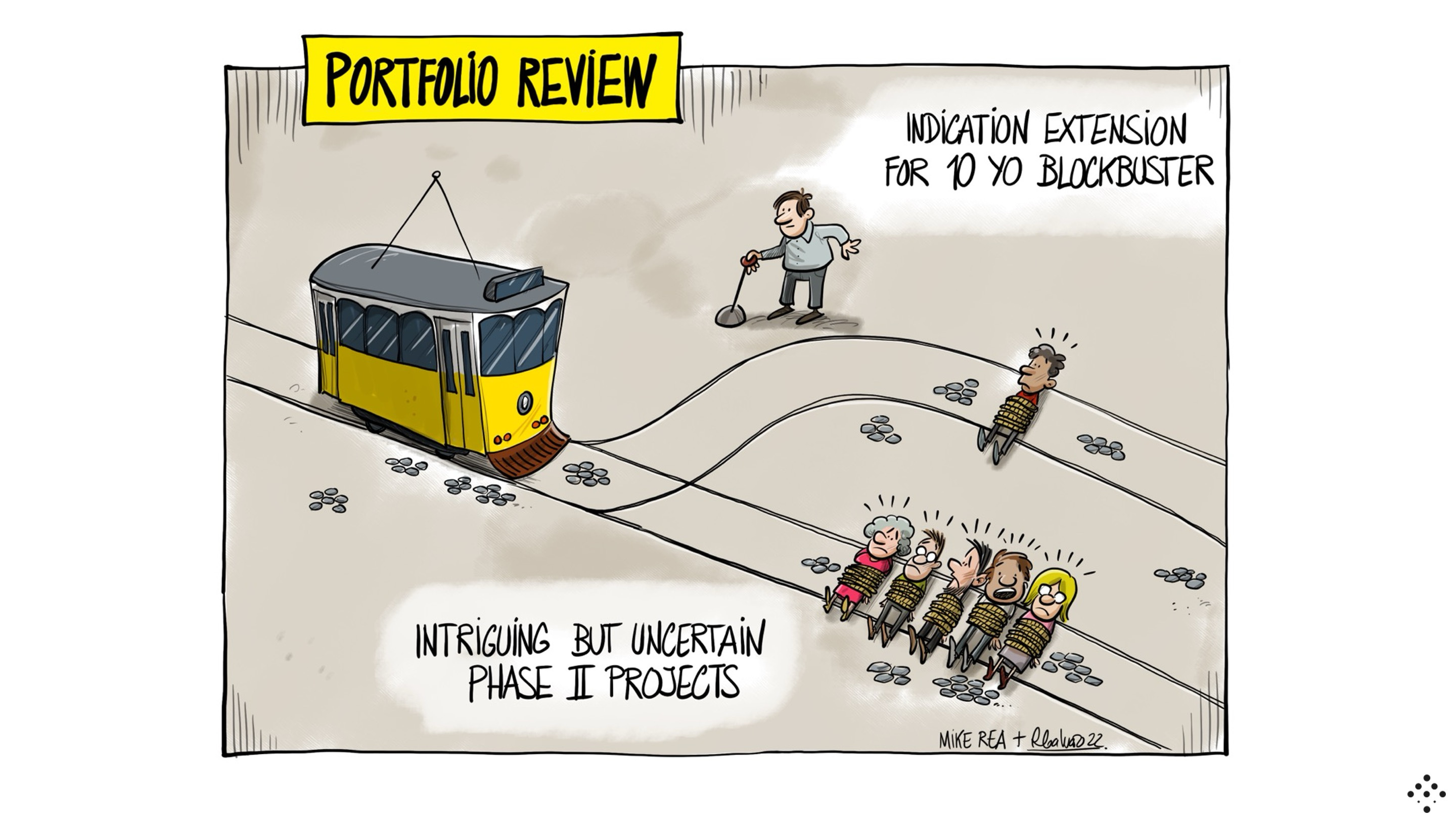
This post is a confession of sorts. Ideally, it’s the best one to forward to someone… (That’s why it’s here.)
After 300-plus pieces, here’s the simple question it tries to answer: what exactly is the philosophy that ties all this together? If the archive is the footnotes, this is the argument. The question that started my philosophy a couple of decades ago: if you gave the same molecule to two companies, would it end up in the same place? I’ve never met anyone who thought it would, but we operate in an industry that seems to believe the answer is ‘yes’.
1. The uncomfortable starting point
Pharma innovation matters more than ever. Yet we routinely sabotage it with the way we choose to run it.
The symptoms are everywhere:
R&D “productivity crises” that are really decision-making, culture, and incentive problems.
Trials that fail not at readout, but in the design assumptions months or years earlier.
Launches that feel like acts of faith rather than the logical endpoint of a coherent journey.
A stubborn preference for certainty theatre over honest uncertainty.
The premise of this blog isn’t that pharma is broken or that people are stupid. It’s that we’ve normalised ways of working that leave huge amounts of value - and learning - on the table. This blog exists to poke at that normal.
2. Asymmetric learning: the quiet edge
The name isn’t just branding; it’s the thesis.
Back in 2020, I wrote about asymmetric learning as the hidden advantage behind some of the biggest biopharma successes. The market has kindly kept supplying fresh case studies ever since.
By it I mean:
Learning more than your competitors from the same (or less) activity.
Designing programmes where even “failures” teach you something useful - about biology, patients, endpoints, or your own judgement.
Structuring decisions so the downside is bounded but the informational upside is essentially unlimited.
In practice this shows up as real-time trials, smart externalisation, partnerships that shift risk while accelerating insight, and launches treated as live experiments rather than one-off events.
Companies that bake this into their culture, portfolio, and commercial approach quietly outperform those still trapped in the prediction-and-de-risk paradigm. The data keeps voting the same way.
3. Premise → Proof → Promise: the development backbone
One of the more explicit posts in the archive lays out the three-word sequence that underpins everything here.
Premise: What do we actually believe, and why might it matter in the real world? This is where the sharp hypothesis about target, mechanism, patient, and unmet need lives. Not a slogan - a testable story.
Proof: What evidence would genuinely change our mind, positive or negative? This is about asking real questions, not just generating registrable p-values.
Promise: If the premise holds, what is the authentic promise to patients, payers, and the business? This is where product profile, access, and launch strategy matter.
Most development gets this sequence backwards: Promise first (peak sales decks and lifecycle fantasies), then a Proof programme reverse-engineered to support it, then frantic fudging of the Premise when reality bites.
The philosophy here is simple: earn your Promise by being ruthless about Premise and Proof. When the sequence is clear, TPPs, trial design, and launch execution stop feeling like art and start looking like disciplined craft.
4. Innovation theatre vs actually wanting to know
The recurring villain is innovation theatre - those glossy labs, patient-centricity videos, AI press releases, and “fail fast” posters that somehow never survive contact with reality.
Fifteen years on, the symptoms are depressingly familiar.
Behind it all sits a harder question: do you actually want to know?
Asymmetric learning only works when the real incentive is discovering the truth, not confirming the PowerPoint. Many studies are effectively dead before they start - not because the science was impossible, but because the design quietly avoided uncomfortable comparisons, the endpoints were chosen to be passable rather than decisive, and the team needed the study to succeed more than it needed to learn.
The most radical thing a pharma company can do is genuinely prefer the right answer over the favourable one.
5. Incentives, Freshness, and the quiet death of innovation
If there’s one explanatory variable running through the archive, it’s incentives. Whenever smart, well-paid people keep doing obviously suboptimal things, the question is always the same: what are they being rewarded (or punished) for?Recurring patterns:
R&D teams rewarded for starts, not intelligent stops.
Leaders promoted for ownership of big budgets rather than decision quality.
Organisations that quietly default to the Compromise Product Profile (CPP) over the differentiated Target Product Profile (TPP), or ideally the Target Opportunity Profile, because compromise keeps more stakeholders happy - even as it kills the product.
Add in the issue of Freshness: portfolios clogged with old, comfortable bets that crowd out sharper new ones. Option sets that collapse too early to “one big bet” - even though one remains the second-worst number of options in pharma.
Opportunity cost is real. Freshness - the rate at which you generate and act on new options - often matters more than any single asset. CPPs are where innovation goes to die politely.
Change the incentives and what you tolerate, and different outcomes become possible.
6. Strategy and launch: discipline, not destiny
Strategy isn’t a mood or a strapline; it’s the set of things you’re willing not to do.
In launch, the same logic applies. First-mover advantage is overrated. The winners are usually those who design development with launch in mind, build an information edge on patients/prescribers/payers before Day 1, and keep learning - and acting - faster than competitors after approval.
Launch isn’t an event. It’s Premise → Proof → Promise continuing in the real world, now with a revenue line attached.
7. Thinking tools, not complicated diagrams
Not every post is about molecules and markets. Some are about how to think better.
You’ll find simple models (Freshness, Premise → Proof → Promise, binoculars vs eyes, the two worst numbers of options), analogies from spies, poker, and aviation, and a consistent push toward Bayesian habits: good priors, rapid updating, refusing to be surprised twice by the same thing.
The meta-philosophy is straightforward: serious work deserves simple, sharp tools you can actually use on Monday morning.
8. Tone: high stakes, low solemnity
The subject is serious - lives, science, billions, careers. The tone deliberately isn’t.
Plain language, mild irreverence when deserved, and a willingness to call expensive nonsense what it is. Underneath the occasional sharpness is stubborn optimism: pharma can be much better than it is, and some companies and teams already prove it.
9. What this blog is actually for
After all these posts, here’s the closest thing I have to a mission:
To show that asymmetric learning is a practical, repeatable edge - in how you choose, run, and launch programmes.
To make the hidden costs visible: of CPPs, anaemic trial designs, performative cultures.
To give serious people in and around pharma ideas and examples that help them make slightly better decisions under uncertainty.
This isn’t neutral corporate thought leadership. It’s a long, evolving argument that you can design for Premise → Proof → Promise, reward wanting to know, and treat every trial, partnership, and launch as an asymmetric learning opportunity.The market keeps rewarding those who do.
10. How to use the archive
If you’re new:
Start with the philosophical anchors: Premise → Proof → Promise, The Real Reason Pharma Studies Fail Before They Start, Innovation Theatre in Pharma (15 Years Later), Opportunity Cost, and The Market Keeps Voting for Asymmetric Learning.
Then pick a case study (GLP-1s, CAR-T, real-time trials, biotech M&A) and read it through this lens.
Finally, look at your own world and ask the practical questions: Where are we choosing CPP over TPP? Where are we pretending to want the answer when we really want the outcome? Where could we design for more learning at lower cost?
If even one decision lands differently because something here shifted your prior, the whole exercise will have been worth it.
A terrific entry point for the uninitiated, Mike. You lay out the fundamentals in a way that should be difficult to ignore.